How Many Sockets per Circuit? The AREI Rule
At most 8 sockets per final circuit, and a multiple socket counts as one: how to count, choose cable and breaker, and plan lighting and dedicated circuits under the AREI.
 AuthorStephan Behm
Maximum 8 sockets per circuit
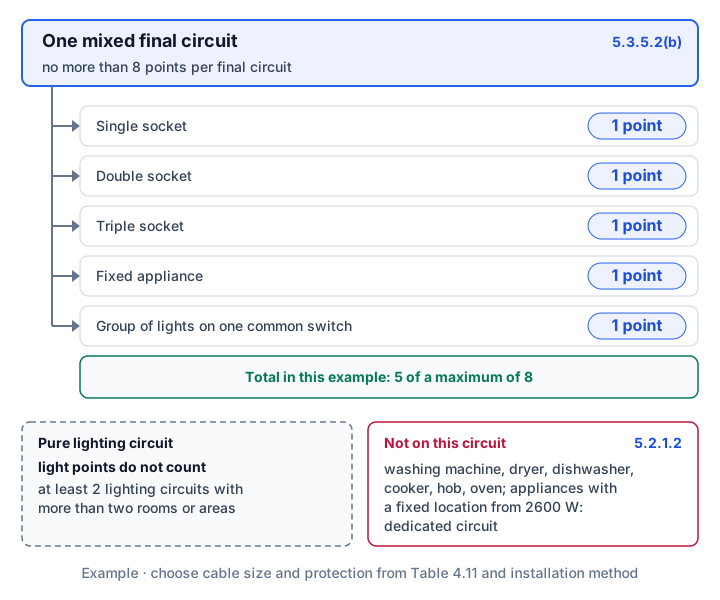
A final circuit in a dwelling feeds at most eight single or multiple socket outlets. That is the rule in Book 1 of the AREI/RGIE, Belgium's general regulations for electrical installations, subsection 5.3.5.2, point b. A double or triple socket counts as one point. Pure lighting circuits have no fixed cap; instead, every dwelling unit with more than two rooms or areas needs at least two separate lighting circuits.
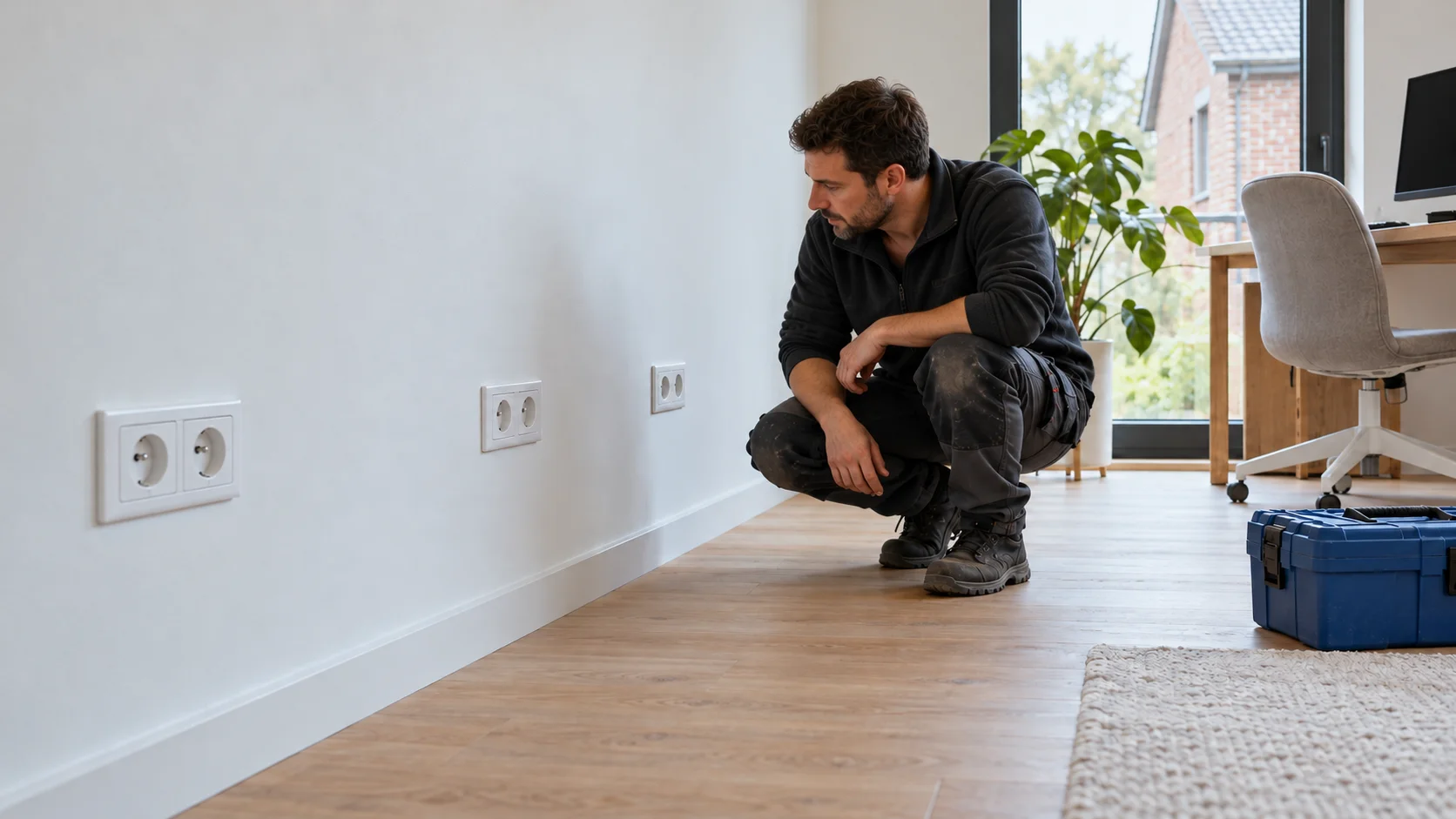
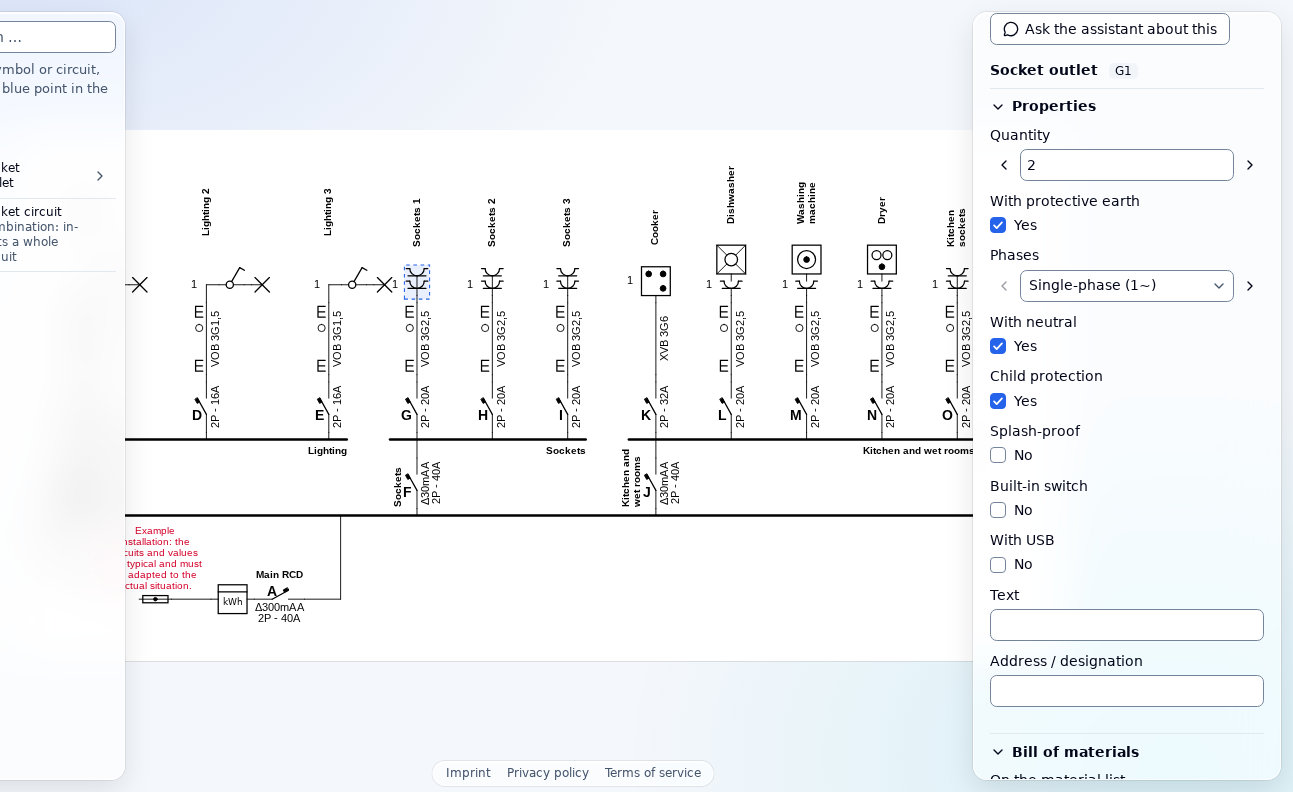
In PlanElec Sketch: you draw every socket circuit for free in the browser, with a letter per circuit and a designation such as "B3" per socket that stays the same in the single-line diagram and the situation plan. You count the points yourself; Sketch does not check AREI rules. Prepare a house in Sketch
How to count
| Connection | Counts towards the limit of eight |
|---|---|
| Single socket | 1 point |
| Double or triple socket | 1 point |
| Light point on a pure lighting circuit | does not count |
| Fixed appliance on a mixed circuit | 1 point |
| Group of lights or appliances with one common control (mixed circuit) | 1 point |
| Appliance with a dedicated circuit (5.2.1.2) | does not belong on the socket circuit |
Mixed circuits are allowed: sockets, luminaires and other fixed appliances may share a final circuit. The socket rule then applies to the whole circuit, and each fixed appliance – or each group behind one common switch – counts as one socket (5.3.5.2 b).
Cable and breaker per circuit type
| Circuit type | Typical cable | Max. circuit breaker (table 4.11) | Max. points |
|---|---|---|---|
| Sockets | XVB 3G2.5 | 20 A (fuse: 16 A) | 8 |
| Lighting | XVB 3G1.5 | 16 A (fuse: 10 A) | no fixed cap; at least 2 lighting circuits |
| Dedicated circuit 4 mm² | XVB 3G4 | 25 A (fuse: 20 A) | 1 appliance |
| Dedicated circuit 6 mm² | XVB 3G6 | 40 A (fuse: 32 A) | 1 appliance |
Table 4.11 in subsection 4.4.1.4 gives the maximum rated current per cross-section for domestic installations. Installation method, grouping and cable length can call for a larger cross-section; the method is in cable cross-section and breaker. Socket circuits need at least 2.5 mm²: under table 5.1, 1.5 mm² is only allowed for circuits without sockets.
Which appliances need their own circuit
Subsection 5.2.1.2 takes certain appliances off the socket circuit altogether. In domestic installations, every appliance with a fixed location rated at 2600 W or more gets its own circuit. The washing machine, dishwasher, tumble dryer, electric cooker, hob and oven each get a dedicated circuit regardless of their power; fixed electric heating gets one or more separate circuits. Details and examples are in dedicated circuits for appliances.
How to split a house into circuits
- Place sockets room by room. Start from what each space needs, not from circuits.
- Group them into circuits. Combine neighbouring sockets into final circuits of eight points at most. If you want more spare capacity or availability, plan smaller circuits.
- Separate the dedicated circuits. Everything listed in 5.2.1.2 gets its own circuit.
- Spread the lighting. At least two lighting circuits, so one trip does not leave the whole home in the dark.
- Number consistently. Circuit and point numbers match on the single-line diagram and the situation plan.
How many circuits a house ends up with follows from these steps – not from a rule of thumb.
You can draw these steps for free in the browser with PlanElec Sketch: every circuit gets a letter, every device a designation such as "B3" that stays the same in the single-line diagram and the situation plan. Open Sketch. Sketch does not count points against AREI; you do that yourself or with the self-check in Pro.
Existing installations: more than eight only in existing parts
Part 8 lets existing domestic installations keep more than eight sockets per final circuit in service, provided the power of the connected fixed appliances and appliances with a fixed location does not exceed the permissible power of the wiring (section 8.2.1, item 6, for installations started before 1 October 1981; section 8.2.2, item 6, for installations under the former AREI). The derogation covers existing parts. New or modified circuits follow 5.3.5.2. More in old buildings and AREI Part 8.
How PlanElec counts
In PlanElec Pro, the AREI/RGIE self-check counts sockets and fixed appliances per final circuit and flags more than eight as an error; pure lighting circuits are excluded. It also checks for at least two lighting circuits and for a dedicated circuit for large appliances. You see overruns while you design. The self-check shows you open items; the inspection of the installation is carried out by the approved inspection body. The rules covered are listed in what the self-check verifies. Pro, with distribution board and self-check report, is aimed at installers: PlanElec Pro. PlanElec Sketch draws and documents but does not count against AREI.
Official source: AREI Book 1, version 06, subsections 4.4.1.4, 5.2.1.2 and 5.3.5.2 and Part 8.
Related articles
Start from your house
PlanElec Sketch prepares a house: lighting, sockets, kitchen and utility room. You adapt the circuits and protective devices to your installation.
Fictitious sample dossier, available without sign-up.