AREI coverage
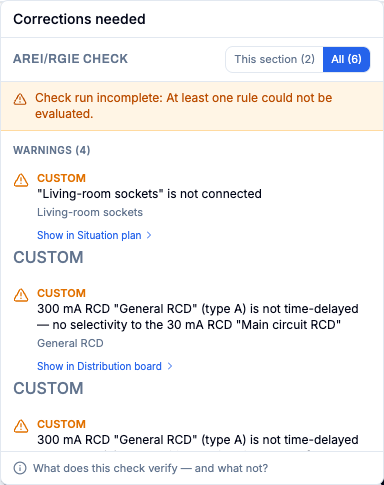
What does PlanElec's AREI self-check verify?
The complete list of rules PlanElec checks automatically — and an equally explicit list of what the self-check does not assess.
 AuthorStephan Behm
PlanElec contains two things that are easily confused.
AREI/RGIE references are linked publicly only after the documented source and subject-matter approvals. Practice rules and plausibility checks make no claim to quote the regulations.
The automatic self-check covers only part of it. This page states exactly which part. We list the rules that are checked and, just as plainly, the areas where the application makes no statement — because an incomplete check presenting itself as complete is more dangerous than no check at all.
The self-check is preparation. Only an accredited inspection body issues the official assessment.
What is checked automatically
The application currently holds 56 checks. Of these, 29 point to a specific AREI article; the remaining 27 are practice rules or plausibility checks, marked as such, carrying no regulatory obligation.
A check only produces a result once the required project data has been entered. Where data is missing, the report marks the check as incomplete — never as passed.
Protection
| Check | What is verified | Basis | Severity |
|---|---|---|---|
| Main RCD | A residual current device of at most 300 mA must be present at the head of the installation. | AREI 4.2.4.3 | Error |
| Max. circuits per high-sensitivity RCD | At most 8 final circuits per high-sensitivity residual current device (≤ 30 mA). | AREI 4.2.4.3.b | Error |
| Shutter actuator ratings | DIN-rail shutter actuators require an upstream MCB or RCBO; protective-device and motor loads stay within the catalogued input and channel ratings. | Practice rule | Error |
| Charging-point protection (EV charging) | A charging point requires its own circuit, a dedicated residual current device and at least IP44 outdoors. | AREI 7.22.4 | Error |
| RCD selectivity (practice recommendation) | Practice recommendation: grade sensitivity and time between upstream and downstream RCDs (IEC 60364-5-53). | Practice rule | Warning |
| 30 mA RCD for socket circuits | All socket circuits must be protected by a 30 mA residual current device. | AREI 4.2.4.3.b | Error |
| Surge protection (SPD) | The presence of a surge protective device (SPD) is assessed; the AREI imposes no general obligation. | AREI 4.5.1 | Information |
| Main switch min. 40 A | A main switch must be present and rated at least 40 A in domestic installations. | AREI 5.3.5.1.b | Error |
| Main RCD min. 40 A | The residual current device at the supply point must be rated at least 40 A. | AREI 5.3.5.3.a | Error |
| Distribution-board layout | Board: occupancy within the module count, one residual current device per row and roughly 20 % spare capacity. | Practice rule | Warning |
| Embedded wall heating: 100 mA RCD | Heating elements embedded in walls above 25 V AC require a separate 100 mA residual current device. | AREI 4.2.4.3.b | Error |
| Pole configuration in residential installations | Single-pole breakers are not permitted in Belgian dwellings with a star configuration; use 1P+N. | AREI 4.4.4.2 | Warning |
| Trip characteristic versus load type | Practice recommendation: the breaker curve B, C or D must match the load type. | Practice rule | Warning |
| Feeder back-up protection between distribution boards | A feeder to a sub-board requires its own protective device in the supplying board and a consistent link. | AREI 4.4.1.4 | Error |
| Breaking capacity versus prospective short-circuit current | The breaking capacity of each breaker must withstand the prospective short-circuit current; checked only when the value is recorded. | AREI 5.3.5.5 | Error |
Earthing
| Check | What is verified | Basis | Severity |
|---|---|---|---|
| Main equipotential bonding | A main equipotential bonding rail must be present. | AREI 4.2.3.2 | Error |
| Earth electrode (ring earth/earth rod) | For a TT or IT system, an earth electrode must be documented. | AREI 4.2.3 | Error |
| Earthing and supply plausibility | Plausibility check: a public domestic 3×230 V connection recorded as a TN system requires review. | Practice rule | Warning |
Cables and sizing
| Check | What is verified | Basis | Severity |
|---|---|---|---|
| Cable cross-section | The cable cross-section must match the rating of the protective device. | AREI 5.2.2 | Error |
| Voltage drop (ΔU) | Voltage drop computed from cable length: guide value 3 % for lighting and 5 % for other final circuits. | AREI 5.2.5 | Error |
| CPR cable fire-performance class | Individually laid cables must have the F1 property or reach at least CPR class Eca; class Fca is not permitted. | AREI 5.2.7.2 | Error |
| Cables in hollow walls: Cca/Preflex | Cables in building cavities run in conduit (Preflex) or reach at least CPR class Cca. | AREI 4.3.3.5.b | Error |
Circuit loading
| Check | What is verified | Basis | Severity |
|---|---|---|---|
| Automation: channel load | Compares current calculated from documented load powers with the entered channel rating. Missing power or rating is a data gap. Does not check inrush current, power factor or internal protection. (AREI 4.4.1.1) | AREI 4.4.1.1 | Error |
| Automation: known bus current | Compares known device and catalog currents with the planned bus capacity. Planning warning based on the profile catalog, no numerical AREI limit; safety objective AREI 4.4.1.1. | Practice rule | Warning |
| Max. contact points per final circuit | At most 8 sockets and fixed appliances per final circuit; lighting-only points are not counted. | AREI 5.3.5.2b | Error |
| Phase imbalance | Practice recommendation: imbalance between phases should stay below 30 %. | Practice rule | Warning |
Rooms and zones
| Check | What is verified | Basis | Severity |
|---|---|---|---|
| 30 mA protection for wet rooms | Sockets in damp rooms must be protected by a 30 mA residual current device. | AREI 4.2.4.4 | Error |
| 30 mA RCD for bathroom circuits | All circuits in bathrooms and damp rooms must be protected by a 30 mA residual current device. | AREI 7.1.4.3 | Error |
| Bathroom zones 0/1/2: permitted equipment | In bathroom volumes 0, 1 and 2 only certain equipment is permitted; distribution boards are prohibited there. | AREI 7.1.5.2 | Error |
| Pool zones 0/1/2: equipment within the inspection zones | Equipment located in swimming-pool zones 0, 1 and 2 is reported as an inspection notice; the requirements of AREI 7.2.3 ff. must be checked by a professional. | AREI 7.2.2 | Information |
| Smoke-detector coverage (recommendation) | Non-binding advice based on regional housing rules; the AREI itself does not mandate smoke detectors in dwellings. | Practice rule | Warning |
Topology and control
| Check | What is verified | Basis | Severity |
|---|---|---|---|
| Electric shutter control paths | Plausibility check: direct switches, actuator inputs, central controls and drive types together form a consistent control path. | Practice rule | Error |
| Project integrity | References between diagram, situation plan and distribution board must point to existing objects. | Practice rule | Error |
Photovoltaic installation
| Check | What is verified | Basis | Severity |
|---|---|---|---|
| PV installation compliance | PV installation: anti-islanding, earthing of module frames, warning signs and identification of DC and AC conductors. | AREI 7.112.2 | Error |
| PV string design | Checks strings against the documented manufacturer limits of the inverter and modules. | Practice rule | Error |
| Combined current in distribution boards with multiple sources | In a board with local generation, grid and source currents add up per phase on jointly loaded sections. | Practice rule | Error |
Completeness of the file
| Check | What is verified | Basis | Severity |
|---|---|---|---|
| Automation: controls in the diagram | For domestic installations, checks whether existing control points appear in the actual diagram input. Missing assignments can be completed in the channel matrix or through the module supply path. Not a complete symbol or extra-low-voltage check. (AREI 3.1.2.1.a) | AREI 3.1.2.1 | Error |
| Automation supply protection | Planning check: supply protection, bus supply and unique, complete channel assignments must be documented. A finding blocks final export; this is no additional AREI requirement. | Practice rule | Error |
| Unique load assignment | Planning check: supply protection, bus supply and unique, complete channel assignments must be documented. A finding blocks final export; this is no additional AREI requirement. | Practice rule | Error |
| Bus supply | Planning check: supply protection, bus supply and unique, complete channel assignments must be documented. A finding blocks final export; this is no additional AREI requirement. | Practice rule | Error |
| Actuator configuration | Planning check: supply protection, bus supply and unique, complete channel assignments must be documented. A finding blocks final export; this is no additional AREI requirement. | Practice rule | Error |
| Devices per line | Planning warning based on the profile catalog: Devices per line. Limits and assignments come from the profile catalog, not from AREI. | Practice rule | Warning |
| Lines per system | Planning warning based on the profile catalog: Lines per system. Limits and assignments come from the profile catalog, not from AREI. | Practice rule | Warning |
| Profile channel load | Planning warning based on the profile catalog: Profile channel load. Limits and assignments come from the profile catalog, not from AREI. | Practice rule | Warning |
| Channel kind and load | Planning warning based on the profile catalog: Channel kind and load. Limits and assignments come from the profile catalog, not from AREI. | Practice rule | Warning |
| Line assignment | Planning warning based on the profile catalog: Line assignment. Limits and assignments come from the profile catalog, not from AREI. | Practice rule | Warning |
| Line coupler | Planning warning based on the profile catalog: Line coupler. Limits and assignments come from the profile catalog, not from AREI. | Practice rule | Warning |
| Voltage classes per bus line | Checks SELV together with FELV or LV on the same bus line (AREI 4.2.5.5.c). Warns about a logical contradiction; does not establish physical connections or source quality. | AREI 4.2.5.5.c | Warning |
| Complete connections | Every element in the diagram must be connected; orphan nodes indicate an incomplete model. | Practice rule | Warning |
| Minimum number of lighting circuits | Practice recommendation: at least two lighting circuits per dwelling unit. | AREI 5.3.5.2.b | Error |
| Dedicated circuits for large appliances | Large appliances such as washing machine, dryer, dishwasher, hob and oven each require a dedicated circuit. | AREI 4.3.3.3 | Error |
| Installation dossier (AREI 9.1.2) | The installation file requires a single-line diagram, a situation plan and a complete title block; PV needs additional documents. | Practice rule | Warning |
| Placement of connection/junction boxes | Structural junction boxes must appear exactly once and consistently in the diagram. | AREI 3.1.2.3 | Warning |
| Consumers placed on the situation plan | Consumers from the single-line diagram must be placed on the situation plan through their link. | Practice rule | Warning |
| Unlinked electrical floor-plan symbols | Floor-plan devices without a link to the electrical topology are reported for information. | Practice rule | Information |
| Switch-control group plausibility | Plausibility check: a control group contains at least one switch and at least one switched load. | Practice rule | Warning |
Domotica
This section contains AREI checks, mandatory planning checks and profile warnings. It does not certify the entire extra-low-voltage installation, manufacturer conformity or physical bus routing. The bus supply source type cannot be recorded in the model (AREI 4.2.5.3.a).
Areas not checked automatically (not passed checks):
Disabled: not every internal extra-low-voltage component can be recorded and represented in the diagram. The claimed blanket June 2023 change is not established here. Only the documented control-point check is active.
Disabled: no evidence for a blanket requirement for a dedicated 30 mA bus circuit; type A is a general RCD requirement.
Disabled: cable adjacency, distance and insulation evidence cannot be recorded. The regulation permits several separation measures.
No automated symbol check: Table 2.23 J specifies the control-unit symbol (AREI 3.1.2.1.a). Users cannot correct missing catalog or renderer geometry.
What the self-check does not assess
These areas of Book 1 deliberately remain outside the automatic check:
Special installations and locations (Part 7). Of fourteen chapters, PlanElec touches three, each only in part: rooms containing a bath or shower (7.1), supply of electric road vehicles (7.22) and domestic photovoltaic installations (7.112). Not covered: swimming pools (7.2), saunas (7.3), construction sites and outdoor installations (7.4), conductive confined spaces (7.6), camping sites (7.8), marinas (7.9), fairground installations (7.11), fountains (7.100), stationary vehicles (7.101), explosive atmospheres (7.102) and industrial accumulator batteries (7.103).
The direct-current side. The model has no separate roles for the L+, L-, M, PEM and PEL conductors. Conductor selection, colouring, combined protective conductors, DC residual current sensitivity, protection of the M conductor and permanent insulation monitoring in an IT system are therefore not verifiable. For photovoltaics this remains manual work.
The transitional provisions of articles 59 and 69. Whether an exception applies to an existing installation depends on data that cannot be derived from a single-line diagram — among others the PEN cross-section, the actual start of work on site and the presence of a monitoring device. PlanElec does take the relaxations of Part 8 into account by presenting certain findings on existing parts as indications rather than errors, but does not decide the exception itself.
Inspections of installations (Part 6) and the rules of conduct (Part 9) fall outside the reach of a planning tool. Only the composition of the installation file is checked.
What software cannot establish in principle
Even after further extension of the model, these points remain dependent on measurement, documentation or visual inspection on site:
- the actual wiring, continuity and polarity of the conductors;
- the tripping characteristics and DC suitability of the devices actually installed;
- insulation measurement and the operation of a permanent insulation monitoring device;
- the mechanical and chemical resistance and corrosion state of the earthing;
- the effectiveness of automatic disconnection and the real earth impedance;
- the suitability and certification of inverters, batteries and PV components;
- zoning, risk assessment and on-site conditions.
What this means for your inspection
Use the self-check to catch avoidable mistakes early: a missing residual current device, a cross-section that does not match the protection, too many contact points on one circuit, an incomplete file. These are exactly the findings that otherwise surface only at inspection.
Do not rely on it for the cases listed above. There, your expertise and the judgement of the accredited body remain decisive.
Important for electrical planning
These guides explain the software workflow. Have the design, installation and documents reviewed by a qualified electrician where needed; only an accredited inspection body performs the official inspection.
Continue reading
Getting started: from project to first export
Build a PlanElec project step by step: project details, floor plan, rooms, electrical devices, distribution board, diagram, and export.
Using and reviewing automatic planning
Use PlanElec proposals for devices, switch chains, cable routes, circuits, phases, and the distribution board without skipping technical review.